Getting curtains that fit perfectly starts with accurate measurements. Too short and they look unfinished. Too narrow and you lose privacy when they’re closed. Too long and they puddle awkwardly on the floor. You want curtains that hang just right, look polished, and function exactly as they should.
The good news is that measuring for curtains is straightforward once you know what to measure and how to account for different curtain styles. Whether you’re ordering eyelet curtains, S-fold track systems, or classic pencil pleat, each style has specific measurement requirements that affect both the width and drop you need.
This guide walks you through the complete process of measuring your windows for curtains. You’ll learn what to prepare before you start, how to choose between face mount and recess mount, and how to measure the width and drop correctly for each curtain style. We’ll also cover common tricky situations like bay windows and corner spaces so you can measure with confidence.
What to know before you measure
Before you pull out the tape measure, you need to gather the right tools and understand a few key details about your windows. Accurate measurements depend on having proper equipment and knowing which mounting method you’ll use. Take time to prepare so you avoid the frustration of ordering curtains that don’t fit.
Essential tools
You’ll need a metal tape measure that shows millimetres, not a fabric tape that can stretch and give inaccurate readings. Grab a pencil and paper to record your measurements immediately. A step ladder helps you reach the top of tall windows safely, and having someone assist you makes the process easier and more accurate. Keep all your notes in one place so you don’t mix up measurements between different windows.
The most common mistake when learning how to measure for curtains is using a fabric tape that stretches or measuring only once without double-checking.
Note down your window details
Write down each window’s location in your home because windows vary in size even when they look identical. Record whether each window has any obstructions like handles, locks, or architraves that affect how you’ll mount your curtains. Measure every window individually rather than assuming they’re all the same dimensions. Note if you have ceiling cornices, as these affect where you can mount tracks or rods. These details determine your mounting options and ensure you order the correct curtain sizes for each specific window.
Step 1. Plan your mount and hardware
Before you measure anything, you need to decide where your curtains will sit and what hardware you’ll use to hang them. These choices directly affect your measurements because face mounting and recess mounting require different width and drop calculations. Your curtain style also determines whether you need a rod or a track system.
Face mount vs recess mount
Face mount means your curtain hardware sits on the wall above or around your window frame. This method gives you maximum coverage and blocks light from entering around the edges. You mount the rod or track directly onto the wall surface, typically 10-20 centimetres above the window frame. Recess mount fits your curtain hardware inside the window recess or architrave, creating a neat, streamlined look that sits flush with your wall. This works well for windows with deep recesses (at least 30-100 millimetres depending on your hardware) and no obstructions like window handles.
Choose face mount when you want to maximise light blocking and privacy, or recess mount when you want a clean, minimal look and have adequate recess depth.
Hardware requirements for each curtain style
Eyelet curtains require a curtain rod because the fabric loops directly onto the rod through metal rings. Choose a rod diameter that fits through your eyelet openings (typically 25-32 millimetres). S-fold curtains need a track system with carriers and hooks, never a rod, because the S-fold style relies on even spacing along a track. Pencil pleat curtains work with either rods or tracks using curtain hooks that slot into the pleated header tape. Your hardware choice affects how to measure for curtains because tracks add minimal width beyond your measurements, while rods need extra length for decorative finials on each end.
Step 2. Measure width for each curtain style
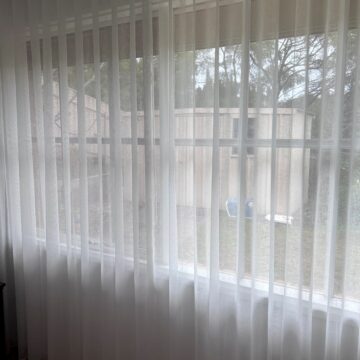
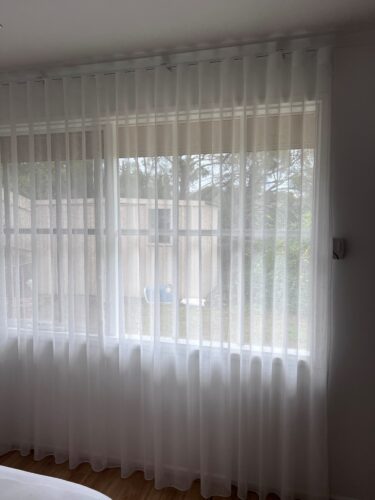
Width measurements change depending on your curtain style because each type hangs differently and needs different amounts of fabric to look right. Eyelet curtains create soft, rounded folds, S-fold curtains form consistent waves, and pencil pleat curtains gather tightly with traditional pleats. You need to measure your window or rod length first, then apply the correct multiplier for your chosen style to calculate the total curtain width you need.
Measure your base width
Start by measuring the actual space where your curtains will hang. For face mount, measure from where you want your rod or track to start to where it will end, typically extending 10-20 centimetres beyond each side of your window frame. For recess mount, measure the width inside your window recess at three different points (top, middle, bottom) and use the narrowest measurement to ensure your curtains fit. Write down this measurement in millimetres as your base width. This becomes the starting point for calculating how much curtain fabric you need based on your style choice.
Measuring at multiple points catches variations in older windows that aren’t perfectly square, preventing curtains that won’t fit properly.
Width calculations for each style
Eyelet curtains need 1.5 to 2 times your base width to create proper folds. Multiply your rod length by 1.5 for a minimal look or by 2 for fuller, more luxurious folds. S-fold curtains require exactly 2 to 2.5 times your track width because the carriers space the folds evenly along the track. Pencil pleat curtains work best at 2 to 2.5 times your rod or track width, giving you dense, traditional gathering. If you want your curtains to stack completely off your window when open, add 30% to your window width before applying these multipliers.
| Curtain Style | Width Multiplier | Example Calculation |
|---|---|---|
| Eyelet | 1.5 to 2 times | 1500mm rod × 2 = 3000mm total curtain width |
| S-fold | 2 to 2.5 times | 1500mm track × 2.5 = 3750mm total curtain width |
| Pencil pleat | 2 to 2.5 times | 1500mm rod × 2 = 3000mm total curtain width |
Divide your total curtain width by two if you’re ordering a pair of curtains that meet in the middle, or keep it as one measurement for a single curtain that pulls to one side.
Step 3. Measure drop for each curtain style
Drop refers to the vertical length of your curtains from the mounting point down to where you want them to finish. Getting the drop right means your curtains hang at the perfect length, whether you want them to hover just above the floor, kiss the floor lightly, or puddle for a luxurious look. Each curtain style sits differently on your hardware, which affects the final drop measurement you need to give when ordering.
Measure your base drop
Identify where your curtain track or rod will sit on your wall or ceiling. For face mount installations, mark this spot with a pencil about 10-20 centimetres above your window frame. For recess mount, your track sits at the top of your window recess. Measure from this mounting point straight down to your desired finish point using your metal tape measure. Take measurements on the left side, centre, and right side of your window because floors and ceilings aren’t always level. Record the longest measurement of the three in millimetres. This accounts for any variations and prevents your curtains from being too short in any spot.
When learning how to measure for curtains, always measure drop in three places because older homes often have uneven floors or ceilings that vary by 10-20 millimetres.
Choose your preferred curtain finish before finalising your drop measurement. Just off the floor means your curtains sit 5-15 millimetres above the floor, which works well in high-traffic areas and makes cleaning easier. Kissing the floor means your curtains just touch the floor with no gap, creating a polished, tailored look. Puddling adds 20-50 millimetres of extra fabric that pools on the floor for a dramatic, luxurious effect in formal rooms.
Drop adjustments for each style
Eyelet curtains hang from the eyelet ring, which sits 20-30 millimetres below the top of the fabric. Measure from your rod position to your desired finish point, then add nothing because the fabric naturally sits below the rod. S-fold curtains attach to carriers on a track with the curtain header sitting at track level. Measure from the track position to your finish point without adjustments. Pencil pleat curtains hook into the pleated header tape, hanging about 20-30 millimetres below your rod or track. Measure from your mounting point to finish and subtract 20 millimetres if using a track, or measure to finish without adjustment if using a rod with the curtain hanging below it.
| Curtain Style | Mounting Position | Drop Adjustment |
|---|---|---|
| Eyelet | Below rod | Measure to finish point (no adjustment) |
| S-fold | At track level | Measure to finish point (no adjustment) |
| Pencil pleat | Below track/rod | Subtract 20mm if needed |
Step 4. Check tricky windows and finalise sizes
You’ve measured width and drop, but some windows present special challenges that need extra attention. Bay windows, corner installations, and angled walls require different approaches to standard flat windows. Before you finalise your order, you need to check for these situations and verify that all your measurements account for any quirks in your home’s architecture.
Bay and corner windows
Bay windows curve outward from your wall in three or more sections. Measure each section individually and order separate curtains for each panel, or measure the full width across the front of the bay for one continuous curved track. Curved tracks work best for bay windows when you want a seamless look, requiring you to measure the exact curve distance (not the straight-line distance) from one end to the other. Corner windows that meet at right angles need two separate curtain sets that overlap slightly in the corner. Measure each wall section from the corner point outward, then add 50-100 millimetres overlap on one side so the curtains meet without gaps when closed.
Measuring the curve distance on bay windows rather than the straight line prevents ordering curtains that are too short to cover the full window area.
Final measurement checks
Double-check every measurement you’ve written down before ordering. Verify your width calculations include the correct multiplier for your curtain style (1.5-2× for eyelet, 2-2.5× for S-fold and pencil pleat). Confirm your drop measurements use the longest of your three readings and account for your desired finish (off floor, kissing, or puddling). Check that you’ve noted which windows need face mount versus recess mount, as mixing these up leads to curtains that won’t fit. Review any obstructions like window handles, air conditioning units, or furniture that might interfere with your curtains when they’re open or closed. Write down your final measurements with clear labels showing which window they’re for and which curtain style you’re ordering.
Your next step with curtains
You now know how to measure for curtains accurately for eyelet, S-fold, and pencil pleat styles. You’ve learned to choose between face mount and recess mount, calculate the correct width multipliers for each curtain type, and measure drop with the right adjustments for your desired finish. Armed with these precise measurements, you can confidently order curtains that fit perfectly and hang beautifully in your Adelaide home.
Quality curtains transform your space by controlling light, adding privacy, and completing your interior design vision. Classic Roller Shutters manufactures Custom Made Curtains right here in Adelaide, giving you access to locally made window coverings that fit your exact specifications. Our experienced team provides free in-home consultations to help you choose the perfect curtain style and confirm your measurements before you order. Visit Classic Roller Shutters Adelaide to explore our complete curtain range and arrange your free consultation today.