Sliding doors let in beautiful natural light and connect your home to the outdoors. But they also create privacy issues and heat problems. Standard blinds and curtains often get in the way when you want to open the door. You end up wrestling with fabric or slats every time you step outside.
Plantation shutters solve this problem. They give you full control over light and privacy while staying out of your way. You can slide them open completely or adjust the louvres to let in just the right amount of light. They look sharp and they last for years.
This guide walks you through everything you need to know. You’ll learn how to plan your layout, choose between sliding and bi fold track systems, pick the right materials, take accurate measurements, and get them fitted properly. Whether you’re doing it yourself or working with an installer, you’ll know exactly what to expect from start to finish.
What to know before you start
You need to understand a few key details about your sliding doors before you choose plantation shutters. Sliding doors vary in width, height, and handle position, and each factor affects which shutter system will work best. Most importantly, you need to measure the backspace (the gap between the glass and the wall) because protruding handles can interfere with louvre operation.
Check your door clearance and hardware
Look at your door handles first. A flush or recessed handle gives you more room for the shutters to operate smoothly. If you have a protruding handle, you might need an extended mounting frame to create enough clearance. Measure from the face of the glass to the furthest point of the handle. You’ll need at least 50mm of clearance for most shutter louvres to tilt properly without hitting the hardware.
Also check the space above your door frame. Bi-fold shutters need an overhead track, so you’ll need around 100mm of clear wall space above the frame. Sliding (bypass) shutters can work with less overhead room. Walk through your door a few times and notice where you naturally reach for the handle. Your shutters will need to clear that spot completely when they’re fully open.
Measuring your backspace accurately at the start saves you from fitting problems later.
Step 1. Plan your shutter layout
Start by deciding how your plantation shutters for sliding doors will open and close. Two main systems dominate the market: sliding (bypass) shutters and bi-fold (track) shutters. Your choice affects everything from how much wall space you need to how often you’ll access your doors. Sketch out your door width and note which side you prefer to stack the shutters when they’re open.
Choose your operating system
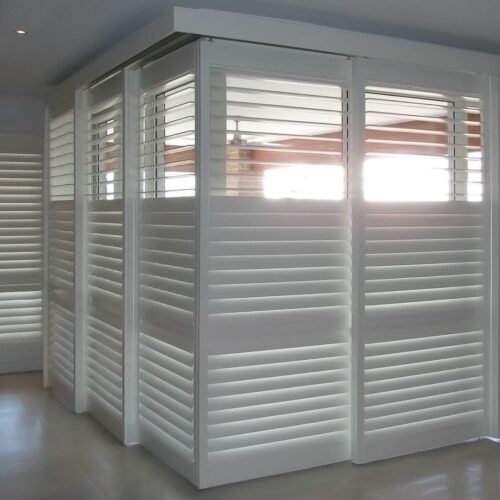
Sliding shutters use parallel tracks where panels stack behind each other. They work well in tight spaces because they stay flat against the wall. You can slide individual panels to overlap as much or as little as you want. Bi-fold shutters accordion out into the room as they fold and slide along a single track. They give you the widest possible opening when fully collapsed, but they need clearance space in front of the door while operating.
Pick sliding shutters if you have limited room or open your doors multiple times daily. Pick bi-fold if you want the cleanest possible view when entertaining and you have the floor space to spare.
Calculate your panel layout
You need to break your door width into manageable panel sections. Each panel should be no wider than 900mm to prevent sagging and maintain smooth operation. Divide your total door width by 900mm and round up to find your minimum panel count.
For a 2700mm wide sliding door:
- 2700 ÷ 900 = 3 panels minimum
- Each panel = 900mm wide
- Stack 3 panels to one side (2700mm stacked space needed)
Planning your panel configuration before you buy saves you from ordering the wrong number of sections.
Step 2. Choose materials and design
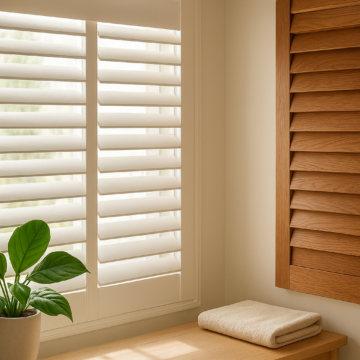
Your material choice determines how long your shutters last and how much maintenance you’ll face. PVC shutters resist moisture and warping better than timber, making them ideal for doors that face humidity or coastal conditions. Timber shutters (usually basswood) give you a premium look and feel but need regular checks for moisture damage. Composite shutters blend both worlds with a timber appearance and synthetic durability.
Match materials to your conditions
Start with your door’s location and exposure. Direct sunlight fades timber faster and warps PVC if you pick a lower grade. Doors near pools, bathrooms, or kitchens need moisture-resistant materials. PVC handles these conditions best, followed by composite, then treated timber.
Budget plays a role too. PVC costs less upfront and needs almost no maintenance. Timber costs more initially but adds resale value. Most Adelaide suppliers stock all three materials, so compare samples in person before deciding.
Pick your louvre size and finish
Standard louvre widths run 63mm or 89mm. Larger 89mm louvres give you wider sight lines and fewer slats to clean, which works well on plantation shutters for sliding doors because of the large surface area. Smaller 63mm louvres suit traditional styles better.
Choose a finish that matches your existing trim. White remains the most popular because it reflects heat and blends with most interiors. Timber stains give warmth but show dust more easily.
Larger louvres mean less cleaning and better views when you tilt them open.
Step 3. Measure your sliding doors
Accurate measurements prevent costly mistakes when ordering plantation shutters for sliding doors. You need three key measurements: width, height, and backspace. Grab a metal tape measure (not cloth, which stretches) and record everything in millimetres. Measure in three spots for width and height (top, middle, bottom for width; left, centre, right for height) and use the smallest measurement. Doors rarely sit perfectly square.
Record your door dimensions
Start by measuring your door’s total width from frame edge to frame edge. Then measure total height from the top of the frame to the floor or threshold. Next, measure your backspace by placing the tape measure against the glass and extending it to the wall. Record the smallest backspace measurement because handle protrusions matter.
Write down these measurements:
- Total width (measure top, middle, bottom): _____ mm
- Total height (measure left, centre, right): _____ mm
- Backspace (measure at handle and at three other points): _____ mm
- Handle projection from glass: _____ mm
- Overhead clearance above frame: _____ mm
Account for mounting space
Your backspace measurement tells you whether you need extended mounting frames or can use standard L-frames. Most shutters need at least 50mm of clearance for louvres to tilt without hitting door hardware. If your handle protrudes more than 30mm, you’ll need a Z-frame or extended L-frame to push the shutters further from the glass.
Check your overhead space too. Bi-fold systems need 100mm minimum above the frame for the track assembly. Measure from the top of your door frame to the ceiling or any obstruction.
Double-checking your backspace measurement prevents the most common fitting problems.
Step 4. Fit and fine tune your shutters
Installation starts with the track system for plantation shutters for sliding doors. Most suppliers provide installation instructions specific to your shutter type, but you’ll follow a similar process whether you choose sliding or bi-fold. Double-check all measurements one final time before drilling any holes. A small error at this stage ruins the entire installation.
Mount your track system
Locate your wall studs using a stud finder and mark drill points along the track mounting line. Bi-fold tracks need solid fixing points every 400mm to support the weight. Use a spirit level to ensure the track sits perfectly horizontal. Even a 2mm slope causes panels to drift and jam.
Drill pilot holes, then secure the track with screws long enough to bite into solid timber (usually 50mm minimum). Hang your panels on the track and test the glide before you finalize anything.
Test and adjust louvre operation
Tilt every louvre rod to check for smooth operation. Sticky louvres usually mean a panel sits too close to the door handle or glass. Adjust your frame spacers outward by 5-10mm if needed. Slide panels back and forth multiple times to check for binding or jumping.
Common problems you’ll spot immediately:
- Panels scraping the floor (adjust floor guides up)
- Louvres hitting door handles (add spacer blocks)
- Track wheels sticking (apply silicone lubricant)
Testing each panel individually before declaring the job finished saves you service calls later.
Bring it all together
You now have everything you need to choose and fit plantation shutters for sliding doors correctly. Start with your measurements, pick the right track system for your space, and select materials that match your conditions. Most Adelaide homeowners complete their installations in a weekend with basic tools and patience.
Classic Roller Shutters supplies and installs plantation shutters across Adelaide with free in-home consultations. Contact us for a quote tailored to your exact door dimensions.