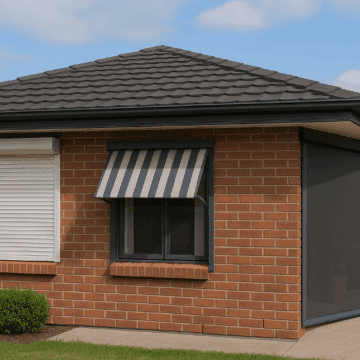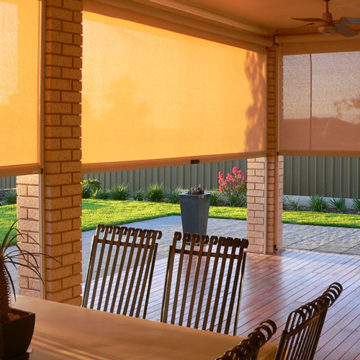
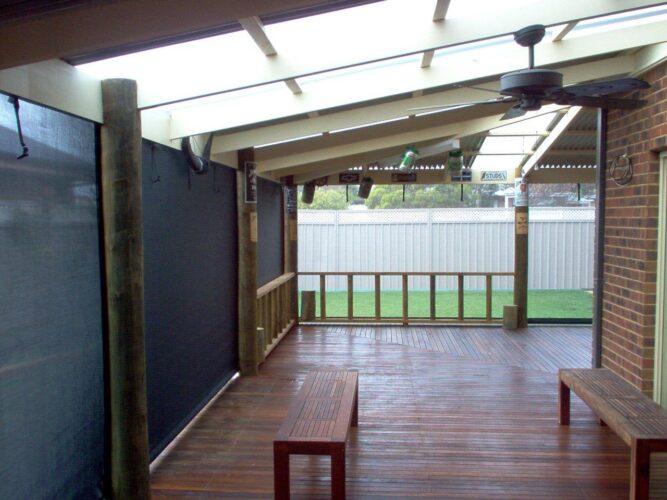
Outdoor veranda blinds are weather-resistant screens fixed to verandas, patios and alfresco areas, shielding you from South Australia’s fierce summer sun, winter drizzle and prying Neighbours while keeping airflow under control. The 2025 range goes further, thanks to advanced mesh fabrics, crystal-clear PVC with UV inhibitors, and whisper-quiet motors that sync with smart homes and comply with the stricter energy-efficiency code.
Whether you’re sketching a new build in Adelaide’s hills or refreshing a tired pergola by the coast, this guide walks you through every decision. You’ll compare Ziptrak, café PVC and shade-mesh systems, scan realistic 2025 price brackets, master accurate measuring, and confirm if council approval is needed. Checklists, maintenance pointers and expert tips follow, leading smoothly into cost tables and brand comparisons.
What Are Outdoor Veranda Blinds and How Do They Work?
Outdoor veranda blinds are purpose-built, weather-tough panels that run vertically from the beam of a veranda, pergola or alfresco ceiling down to the balustrade or floor. Unlike an ordinary indoor roller shade that only filters light, these units create a flexible envelope around your outdoor room—blocking wind, deflecting radiant heat, shedding rainfall and giving you instant privacy at the pull of a handle or press of a remote. By moderating temperature swings they also lighten the load on adjacent indoor air-conditioning, a handy plus under 2025’s tightened NatHERS energy rules.
Homeowners from Adelaide’s parched northern suburbs to Far North Queensland’s monsoonal coastlines use veranda blinds to convert seasonal spaces into year-round living zones, keep mozzies and flies out during dusk BBQs, and cut glare bouncing off backyard pools.
How Veranda Blinds Differ From Patio, Café and Alfresco Blinds
The terms are often swapped around, but there are useful distinctions:
- Veranda blinds are normally fitted to a fixed veranda roof on a home and prioritise weather sealing.
- Patio blinds serve open pergolas and can include horizontal projection awnings as well as vertical drops.
- Café blinds—clear or tinted PVC sheets—aim for maximum visibility in hospitality venues and often roll up with zips or straps.
- Alfresco blinds sit under integrated roofs in new builds, blending architectural lines with colour-matched channels.
Key Components and Mechanisms
A typical system includes:
- Headbox or exposed top tube that houses the fabric roll
- Side tracks, zippers or stainless cables that guide and tension the fabric
- Bottom bar with rubber or brush seal for a snug floor contact
- Operation gear: manual crank, spring-balanced lift or 240 V/solar motor tied into Google Home or Alexa routines.
Ideal Installations and Compatible Structures
Outdoor veranda blinds fix easily to timber beams, galvanised steel posts or masonry walls; you just need 55–75 mm of flat mounting real estate and a square opening. Retrofit kits cope with slight out-of-plumb frames common in older character homes, while bespoke cassettes span up to six metres on modern freestanding pergolas without centre posts.
Types of Outdoor Veranda Blinds Available in 2025
Not every veranda, patio or pergola needs the same level of weather-proofing or tech. The market now spans entry-level DIY vinyl screens through to sensor-driven track systems that seal like a zipper. To help you shortlist the right fit, the table below compares the most common categories you’ll bump into when shopping for outdoor veranda blinds in Australia this year.
| Blind type | Max single span | Wind rating* | Typical price (AUD/m²) | Best for |
|---|---|---|---|---|
| Track-guided (Ziptrak, Slidetrack) | 6.0 m | ≈ 80 km/h | $400–$700 | High-wind suburbs, full weather seal |
| Clear/tinted PVC café | 5.0 m | ≈ 50 km/h | $250–$450 | Hospitality, pool visibility |
| Mesh & shadecloth drop | 5.5 m | ≈ 60 km/h | $300–$550 | Glare & heat control, privacy |
| Folding-arm awning | 7.0 m projection | ≈ 40 km/h | $500–$950 | West-facing decks, retractable shade |
| Motorised/smart upgrade | Matches base system | +5 km/h (steady) | +$450 –$850 extra | Convenience, accessibility |
| DIY roll-up, rope & pulley | 3.0 m | ≈ 30 km/h | $120–$200 | Budget rentals, temporary shade |
*Manufacturer-tested figures; always check local exposure category.
Track-Guided Systems (e.g., Ziptrak, Slidetrack)
These premium blinds run inside slim aluminium channels with a welded zip or spline that locks the fabric on all four sides. Lift it anywhere, stop it anywhere—no straps, no zips to roll. Because the cloth is tensioned, they shrug off Adelaide’s 60 km/h northerlies and stay drum-tight after years of use. Expect to pay $1,600–$2,800 for a typical 4 m × 2.4 m opening, with optional motors adding around $4505 per blind. Downsides? They require a plumb, straight opening and professional install for warranty cover.
Clear and Tinted PVC Café Blinds
Think of the classic bistro vibe on Jetty Road: crystal PVC panels clipped down with zippers or straps. The near-glass clarity keeps your coastal view intact and traps winter warmth, but condensation and heat build-up can be an issue in humid regions. Blinds thicker than 0.75 mm resist creasing; edges need webbing tape to stop shrinkage. They’re lighter on the wallet yet demand careful cleaning to avoid clouding.
Mesh & Shadecloth Drop Blinds
High-tech woven meshes—5 percent openness is a sweet spot—knock out up to 95 percent of UV while letting breezes whisper through. They’re perfect for bushfire-risk fringes where PVC might melt and for neighbours who value daytime privacy. Brands like Visiontex now boast GREENGUARD certification and 10-year fade warranties. Rain will mist through at full tilt, so combine with gutters if total dryness is critical.
Folding-Arm & Retractable Awnings vs Vertical Blinds
A folding-arm awning projects horizontally, creating instant roof cover over a deck, whereas vertical blinds drop straight down to seal the sides. Many homeowners pair the two: arms for overhead shade, tracks for the western flank. Choose an awning when you still want unimpeded airflow and sky views; pick verticals when wind and sideways rain are your main enemies.
Motorised & Smart Home-Ready Blinds
Almost every 2025 system can hide a 240 V or lithium motor inside the top tube. Wi-Fi hubs talk to Google Home or Apple HomeKit, while solar trickle chargers remove the need for hard wiring on remote rural verandas. Add wind or sun sensors and the blinds will raise themselves before a storm—a small price to save a torn panel.
Budget DIY Roll-Up and Rope-Pulley Styles
Bunnings and Spotlight still stock polyethylene, canvas and bamboo roll-ups that you hoist like a ship’s sail. At under $200 per square metre they’re a quick shade fix for renters, but the cords chatter in a breeze and UV will chew through the fabric within three summers. Treat them as a stop-gap, not a forever solution, especially in exposed hills-face zones.
Materials and Weatherproof Features That Matter
Fabric and hardware choice determines whether your outdoor veranda blinds last ten summers or look tired after two. Below is a quick‐glance matrix; detailed notes on each material follow.
| Property | Acrylic canvas | Clear PVC | Tinted PVC | High-tech mesh (5 % openness) | Shadecloth (10 %+) |
|---|---|---|---|---|---|
| UV block | 99 % | 90 % | 94 % | 95 % | 85 % |
| Water resistance | ✔✔✔ | ✔✔ | ✔✔ | ✔ | ✔ |
| Airflow | Low | Nil | Nil | Medium | High |
| Heat retention | High | Very high | High | Medium | Low |
| Daytime privacy | Medium | None | Low | High | Medium |
| Typical warranty | 10 yrs | 3–5 yrs | 3–5 yrs | 10 yrs | 5–7 yrs |
The symbols are relative: more ✔ means better performance in that column.
Acrylic Canvas: The Heavy-Duty All-Rounder
Solution-dyed acrylic canvas is the tank of veranda fabrics. Its dense weave blocks 99 % of UV, sheds rain like a waxed jacket and laughs off Adelaide’s 45 °C northerlies without sagging. Modern brands apply fluoro-carbon coatings that resist mould and staining; expect colourfastness for a decade when cleaned with mild soap twice a year. Because airflow is low, canvas is ideal on southerly or coastal aspects where wind-driven rain is the bigger issue than trapped heat.
PVC: Clear, Tinted and Window-Film Hybrids
PVC remains unbeatable when you need an uninterrupted view of the garden or to keep an alfresco area toasty during winter dinners. Sheets are extruded at 0.75 mm or 1.0 mm thickness then UV-stabilised. Clear PVC acts like a greenhouse—great for cold hills suburbs, less so for north-facing courtyards in Darwin. Tinted PVC knocks the glare back a peg while still offering visibility. Always roll the blinds up dry; moisture can “milk” the surface and cause clouding. Use a silicone-free polish every six months for best clarity.
High-Tech Mesh & Shadecloth Fabrics
Engineered meshes such as Visiontex or Serge Ferrari Soltis weave PVC-coated polyester filaments into a micro-grid. Openness factors from 1 % to 10 % let you dial in privacy and airflow, while nano-ceramic pigments reflect up to 95 % of solar energy. Because the weave breathes, these blinds avoid the sauna effect common with PVC, making them the go-to for kitchens with BBQ hotplates or pets that need fresh air.
Hardware and Finishes
Even the toughest fabric fails if the structure rusts. Look for powder-coated aluminium extrusions rated 60–80 µm thick; coastal buyers should upgrade to Dulux Duratec or equivalent marine powder. Stainless-steel fasteners in 316 grade prevent tea-staining, and bottom bars fitted with UV-stable Santoprene seals keep draughts and insects at bay.
Sustainability & Eco Credentials
Environmental scrutiny is rising in 2025. Many mesh ranges now carry OEKO-TEX Standard 100 and GREENGUARD Gold, confirming low off-gassing—handy for enclosed play areas. PVC-free polyester options and recycled acrylic yarns are available, though they cost 10–15 % more. If you’re targeting a Green Star build rating, ask suppliers for product stewardship take-back programs to divert end-of-life blinds from landfill.
Choosing the right combination of fabric, hardware and eco rating ensures your outdoor veranda blinds meet both performance goals and personal values for years to come.
Measuring, Installation and Council Considerations
Great-looking outdoor veranda blinds start with millimetre-perfect measurements. Verandas rarely sit perfectly square, so treat every opening as a fresh job, not a copy-and-paste. Measure at least three points both horizontally and vertically, write the numbers on a printed worksheet or phone app, and sketch any downpipes, lights or BBQ flues that might foul the headbox. These notes save time when you’re seeking quotes or claiming on a warranty later.
- Measure the width at the beam/soffit line, mid-span and floor level; record the smallest figure.
- Measure the drop (height) at left, centre and right; use the longest figure for face-mount blinds, the shortest for reveal fits.
- Check diagonal corner-to-corner distances to confirm squareness; >5 mm difference means shims or custom side channels will be needed.
- Note post material (timber, steel, masonry) and thickness for correct fixings.
- Record any fall or slope in the floor that could create a daylight gap under the bottom bar.
- Photograph each opening with a tape measure in frame; it’s handy proof if freight damage or mis-fabrication occurs.
Professional Installation vs DIY Kits
Buying a DIY kit from Bunnings or an online supplier can trim 20–30 % off the upfront bill, but you’ll need a quality impact driver, masonry or timber bits, a second person for lifting, and the confidence to set spring tension or motor limits. Professional installers add around $160 –$250 per blind in labour, yet that includes laser-level accuracy, disposal of off-cuts, public-liability cover and, most importantly, a workmanship warranty that many fabric makers require for their 10-year guarantees.
Do You Need Council Approval? (South Australia & Other States)
Outdoor blinds are classed as “minor building work” in most councils, so approval is seldom required. Exceptions pop up with heritage-listed façades, bushfire overlays (BAL ratings) and strata complexes that regulate uniform colours. In Adelaide, check Plan SA for heritage precincts; in Queensland’s cyclone zones look for mandates on cyclone-rated anchors. When in doubt, a five-minute call to the planning desk beats a compliance notice later.
Electrical & Solar Requirements for Motorised Blinds
Hard-wired 240 V motors need a weatherproof GPO within 500 mm of the headbox and an isolation switch if mounted above 3.5 m. Solar or battery motors sidestep cabling but still need full sun for at least four hours a day and occasional battery swaps every 3–5 years. Leave a 50 mm conduit path during new builds so future upgrades don’t involve ripping down gyprock.
Common Installation Mistakes to Avoid
- Fixing into 70 mm pine without hitting the structural beam—use longer screws or coach bolts.
- Ignoring prevailing wind; blinds that face the gulf breeze in Adelaide need extra centre locks.
- Forgetting fall: a blind installed dead level on a sloping deck leaves a wedge-shaped gap.
- Over-tightening screws on PVC windows, causing cracking.
- Skipping the final tension check; a loose fabric roll flaps, wears and voids most warranties.
Costs and Budget Planning for 2025
Sticker shock is real when you start pricing outdoor veranda blinds, but a clear budget stops the project from ballooning. In 2025, raw material costs, a weaker Australian dollar and stronger demand for smart motors have nudged prices up roughly 6 % on last year. Still, there’s a solution for almost every wallet—from a $300 DIY screen that holds you over for a rental to a $6 000 fully motorised alfresco enclosure that lifts the value of your home. Use the numbers below as a planning compass; final quotes will always depend on site specifics and custom extras.
Key Factors Driving Price
- Size and span: Each extra metre in width bumps material cost exponentially.
- Fabric grade: 1 % openness mesh and solution-dyed acrylics cost more than generic shadecloth.
- Colour customisation: Non-stock powder-coat colours add $180 –$220 per blind.
- Motor and automation: Budget tubular motors start at $400; app-ready systems with sun/wind sensors can reach $800.
- Cyclone or BAL upgrades: Heavier channels, lock-down bolts and stainless hardware add 10–15 %.
How Much Do Ziptrak Blinds Cost in Adelaide?
Classic installs show these ballpark figures (supply & fit, GST inc.):
- 2 m width: $1 150–$1 450
- 4 m width: $1 600–$2 800
- 6 m width: $3 100–$4 400
Add roughly $450 per blind for Somfy or Alpha motors, plus $180 for a multi-channel remote.
Saving with DIY Kits vs Factory-Direct Suppliers
Ordering a flat-packed kit online can shave 20–30 % off list price, but freight to SA on long tubes is rarely under $180. You’ll also carry the measurement risk—one wrong millimetre and the blind won’t click into the tracks. Factory-direct outfits often match DIY material prices yet include professional install, onsite warranty service and shorter lead times.
Warranty, After-Sales and True Cost of Ownership
A cheap blind that needs replacing in four summers is rarely cheaper in the long run. Look for:
- 5–10 yr fabric warranty and written workmanship cover
- Readily available spare parts (motors, splines, bottom seals)
- Local service technicians who can attend within a week
Factor these into your spreadsheet and the “expensive” mid-range track system often wins on lifetime value.
Comparing Leading Outdoor Veranda Blind Brands & Suppliers in Australia
Price, lead-time and after-sales support vary wildly across the Australian market, so it helps to see the front-runners side-by-side before you part with cash. The matrix below summarises what you can reasonably expect when shopping for outdoor veranda blinds in 2025; figures are indicative and assume a mid-grey mesh in a 4 m span.
| Supplier type | Example brands | Core system offered | Installed price bracket* | Typical lead time | Max single span | Fabric / frame warranty |
|---|---|---|---|---|---|---|
| Big-box retail | Bunnings, Spotlight | Rope-pulley vinyl, basic mesh roll-ups | $250–$450 m² (DIY only) | Off-the-shelf | 3 m | 1–3 yrs |
| Specialist manufacturer | Classic Roller Shutters, Australian Outdoor Living, Stratco | Track-guided, motorised mesh/PVC | $400–$1 100 m² (installed) | 2–5 weeks | 6 m | 5–10 yrs |
| Online DIY | Half Price Blinds, OzRite, Budget Awnings | Flat-pack track or cable-guided kits | $300–$650 m² (DIY) | 10–20 days + freight | 5 m | 3–7 yrs |
*Installed price includes GST and standard labour where applicable.
Big-Box Retailers (Bunnings, Spotlight)
Grab-and-go convenience is the big appeal here. You’ll find polyethylene or bamboo roll-ups in set sizes, often under $200 each, making them a quick fix for rental verandas or weekend projects. The trade-off is limited colour choice, minimal weather seals and no on-site warranty; you’ll be the installer—and the service tech—if cords fray or eyelets pop.
Specialist Manufacturers (Classic Roller Shutters, Australian Outdoor Living, Stratco)
These companies measure, make and fit to order, so the blinds hug every millimetre of your structure. Classic Roller Shutters Adelaide, for instance, fabricates locally and offers free in-home quotes, colour-matched powder-coating and integration with shutters or plantation blinds for a cohesive façade. Expect stronger aluminium channels, stainless fixings and 5-to-10-year fabric guarantees. Up-front costs are higher, but so is wind resistance and long-term support.
Online DIY Suppliers (Half Price Blinds, OzRite, Budget Awnings)
If you’re handy with a drill and happy to self-measure, online kits can save 15–25 %. Freight on 4-metre tubes is the hidden sting, and you’ll need to tension springs, square tracks and sort any warranty claims via email. Still, for regional buyers without a local installer, it’s a workable path to quality mesh or PVC systems.
What to Look For in a Reputable Installer
- Current contractor licence and $10 M public liability cover
- Detailed, fixed-price quote showing fabric brand, powder-coat spec and motor model
- Sample books and recent customer references—photos beat promises
- Written workmanship warranty (minimum two years) and clear call-out fees for future service
Tick those boxes and your new outdoor veranda blinds should perform—as well as look—the part for many summers to come.
Care, Maintenance and Troubleshooting
Well-looked-after outdoor veranda blinds can outlive their warranty and keep looking sharp for a decade or more. The good news is the routine isn’t hard; it’s more about consistency than elbow grease, and a little preventative TLC saves pricey call-outs later.
Routine Cleaning Guides by Material
- Acrylic canvas: Hose off dust, then sponge with lukewarm water and a teaspoon of wool-wash per litre. Rinse thoroughly and air-dry before rolling up ‑ never use bleach.
- Mesh / shadecloth: A soft brush and mild detergent lift pollen from the weave. Finish with a low-pressure rinse so grit doesn’t grind inside the tracks.
- Clear or tinted PVC: Wipe with microfibre cloths, cool water and a drop of pH-neutral soap. Apply silicone-free PVC polish every six months to keep clarity and prevent sticking.
Seasonal Maintenance Checklist
- Spring
- Vacuum side tracks to remove cobwebs.
- Check bottom-bar seals for UV cracks.
- Summer
- Tighten any exposed stainless screws that have eased with heat expansion.
- Verify wind-sensor settings on motorised units.
- Autumn
- Inspect fabric for bird droppings and sap—clean immediately to avoid staining.
- Lubricate crank gearboxes with dry silicone spray.
- Winter
- Roll blinds to half-way once a fortnight to relieve spring tension.
- Confirm drainage holes in the headbox are clear of debris.
Simple Repairs vs When to Call a Technician
Do-it-yourself:
- Replace split bottom-bar bumpers.
- Re-thread a frayed pull-cord on budget roll-ups.
- Realign a mesh spline that has popped 10 cm or less out of the track.
Call a pro:
- Motor limit resets that require software tools.
- Ziptrak spline replacement (welded fabric).
- Fabric re-stitching over seams longer than 200 mm—incorrect thread voids warranty.
Upgrading Manual Blinds to Motorised in the Future
Most post-2015 track-guided systems are “motor-ready”, meaning a retrofit tubular motor can slide into the existing top tube. Budget around $550 per blind for the motor, remote and labour, plus a weatherproof GPO if solar isn’t viable. If you’re building now but automating later, ask the installer to leave a 20 mm conduit at the headbox—future-you will thank current-you for the five-minute upgrade instead of a half-day rewiring job.
Frequently Asked Questions About Veranda Blinds
Below are the questions homeowners ask us most when weighing up outdoor veranda blinds. The answers are short, jargon-free and based on the current 2025 standards and supplier data.
What is the best material for Australian conditions?
Solution-dyed acrylic canvas still tops the durability charts, shrugging off 99 % of UV and salty coastal air. For hotter, humid areas a 5 % openness mesh balances shade and airflow without the PVC “greenhouse” effect.
Can outdoor blinds withstand high winds?
Yes—if you pick a track-guided system. Ziptrak and similar products are tested to about 80 km/h when locked down. Rope-pulley or café zips rarely exceed 50 km/h, so position them on calmer sides of the house.
Are veranda blinds waterproof or merely water-resistant?
Clear and tinted PVC panels are effectively waterproof, provided seams are welded and the bottom bar seals flush to the floor. Mesh and canvas are classed as water-repellent: rain beads and runs off, but heavy downpours can mist through.
How long does installation usually take?
A single manual blind under four metres wide is a two-hour job for a licensed installer. Multiple spans or motorised units can stretch the visit to half a day, especially if a new weatherproof GPO needs wiring.
Can I get custom colours or branded prints?
Absolutely. Aluminium channels can be powder-coated in any Dulux or Interpon shade, usually for an $80–$200 surcharge depending on the colour. Mesh fabrics accept UV-stable digital printing, handy for café logos or pool-side signage.
Final Thoughts on Choosing Veranda Blinds
Pick the blind that matches your climate, lifestyle and patience for maintenance, not just the prettiest brochure shot. Track-guided systems offer the best wind seal for exposed suburbs, mesh fabrics keep summer spaces breezy, while clear PVC turns chilly decks into cosy winter rooms. Measure twice, budget for the extras that matter (motors, powder-coat, stainless fixings) and lean on a licenced installer if you want the warranty to stick.
Remember, the cheapest screen you roll up today may cost more over ten summers than a well-built, locally made blind that just works. If you’re in Adelaide or the surrounding regions, grab a free measure-and-quote from the team at Classic Roller Shutters Adelaide and see how factory-direct pricing compares. Your veranda—and your future self-swatting fewer flies—will thank you.