If you’re shopping for Australian made plantation shutters, you’ve probably noticed the market is flooded with imported options that vary wildly in quality, lead times, and after-sales support. Choosing a locally manufactured product cuts through a lot of that uncertainty, you get consistent quality control, shorter wait times, and a supplier you can actually hold accountable if something goes wrong.
But “Australian made” doesn’t always mean what you think it does. Some suppliers import components and only assemble locally, while others manufacture the full product on home soil. Understanding the difference matters because it directly affects durability, customisation options, and the value you get for your money. There’s also the question of materials, not all plantation shutters are built the same, and the right choice depends on where you live and how you plan to use them.
At Classic Roller Shutters Adelaide, we’ve spent over 40 years helping homeowners across Adelaide choose, install, and maintain window coverings, plantation shutters included. We know what performs well in South Australian conditions and what doesn’t. This guide breaks down everything you need to know about Australian made plantation shutters in 2026: what to look for, what to watch out for, and how to make a decision you’ll be happy with for years to come.
What “Australian made” really means in 2026
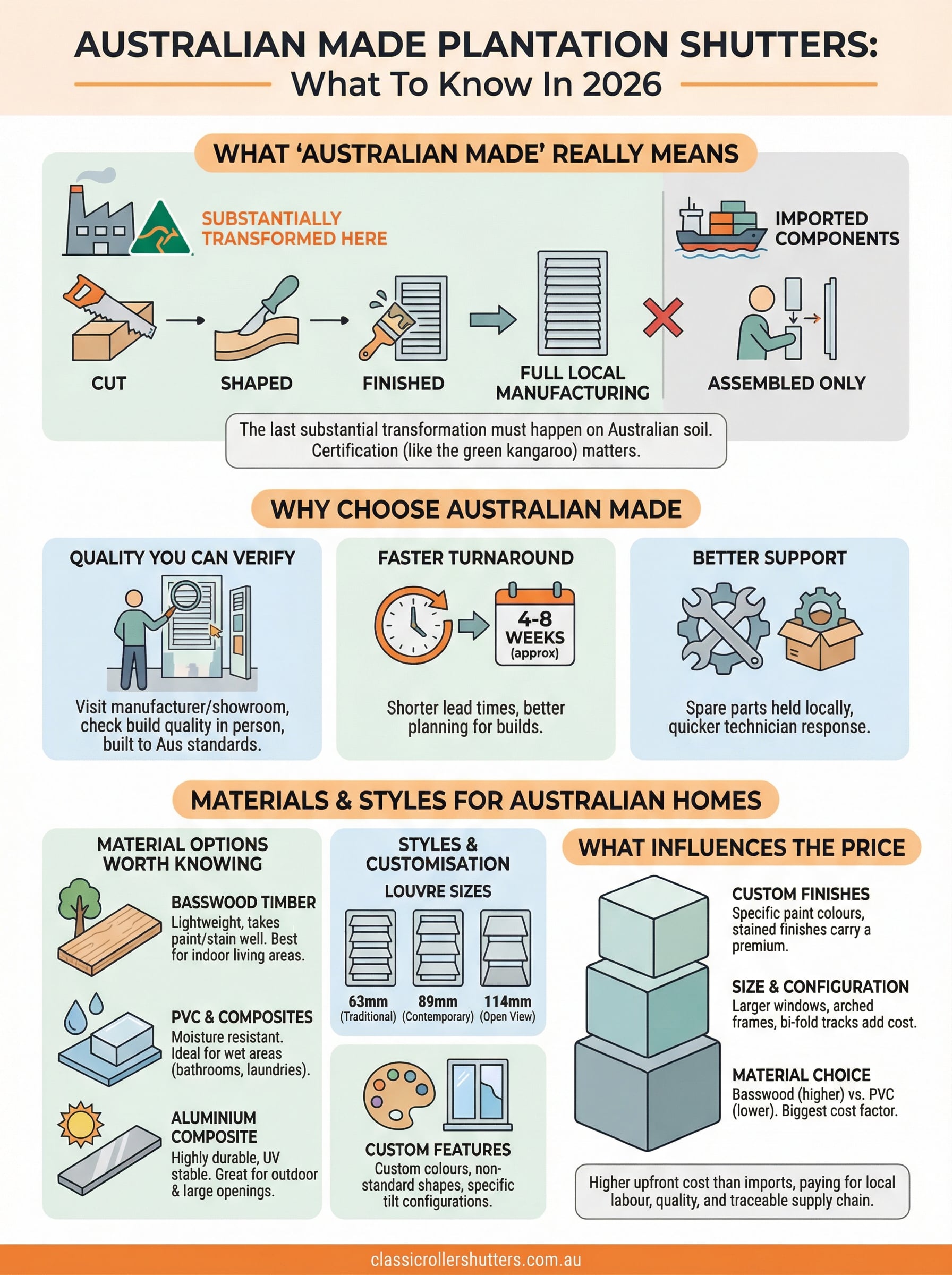
The phrase “Australian made” has a legal definition under the Australian Consumer Law, and it is stricter than most people realise. A product qualifies only if it was substantially transformed in Australia and if that last substantial transformation happened here. For plantation shutters, that means the louvres, frames, and components were cut, shaped, and finished on Australian soil, not simply assembled from pre-made parts shipped in from overseas. In 2026, the number of suppliers blurring this line has grown, so knowing what to ask matters before you sign anything.
The official standard and what it actually covers
Australia’s best-known verification tool for this claim is the green kangaroo logo managed by the Australian Made Campaign. To use it, manufacturers must pass an independent audit confirming their product meets the legal threshold. Asking a supplier whether they hold this certification is one of the quickest ways to separate genuine local manufacturers from those using “Australian made” as loose marketing language. Without it, the claim carries no enforceable weight.
If a supplier cannot point you to certification or a verifiable manufacturing address in Australia, treat their claim with scepticism.
Certification is not the only way to confirm local production, though. Visiting a showroom, requesting details about the supply chain, or simply asking where the shutters are physically built are all reasonable steps. Credible manufacturers welcome those questions because transparency is part of what they sell.
Assembly vs. full local manufacturing
Many suppliers import pre-cut louvres and pre-formed frames from factories in China or Vietnam, clip them together locally, then market the result as Australian made. This sits in a legal grey area, and it affects you directly. When components are mass-produced to an overseas factory’s fixed specifications, your ability to get truly custom sizing, unusual colour matches, or non-standard louvre widths is limited to whatever that factory already offers.
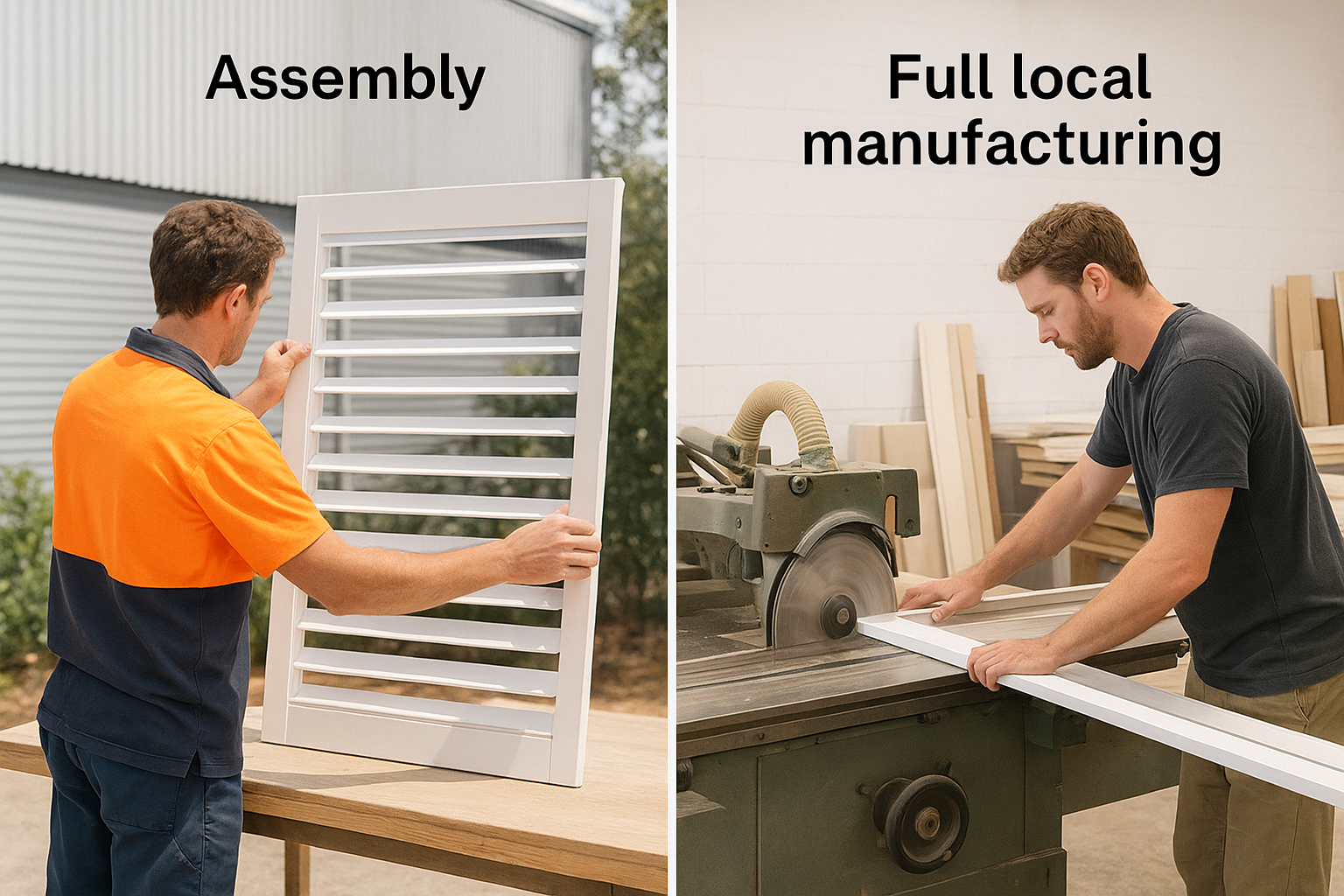
Full local manufacturing works differently. A producer who mills, cuts, and finishes in-house can build australian made plantation shutters to your exact requirements, including non-standard window shapes, split tilt configurations, and custom paint finishes. That level of control is what genuine local manufacturing delivers, and it is the standard worth holding any supplier to when you are comparing quotes and weighing up your options.
Why homeowners choose Australian made shutters
When Adelaide homeowners compare Australian made plantation shutters against imported alternatives, the reasons to buy local quickly stack up. Local manufacturing directly influences product quality, delivery timelines, and the level of support you receive after installation. These are practical differences that affect your day-to-day experience long after the shutters go up.
Quality you can verify in person
One of the biggest advantages of buying locally made shutters is that you can visit the manufacturer or their showroom and see the product before committing. You can check how the louvres sit in the frame, test the tilt mechanism, and ask direct questions about the materials used. That kind of transparency is simply not possible when a product ships from an overseas facility you have never seen.
If a supplier cannot show you a physical sample made in their own facility, that is worth factoring into your decision.
Local manufacturers also build to Australian standards, including relevant building codes and climate considerations specific to regions like South Australia. The materials selected and the construction methods used are chosen with Australian conditions in mind, not adapted from a product originally designed for a different climate entirely.
Faster turnaround and better support
Imported shutters can take eight to sixteen weeks to arrive, and if something is wrong with your order, the resolution process adds even more delays. Australian made products typically come with shorter lead times, often four to eight weeks depending on the manufacturer, which matters if you are working to a build or renovation schedule.
After-sales support is also more straightforward. When your supplier manufactures locally, they hold spare parts on hand and can send a technician quickly if a mechanism fails or a louvre cracks.
Materials and styles that suit Australian homes
Australian homes deal with intense UV exposure, high summer heat, and in coastal areas like Adelaide, salt-laden air. The material your shutters are made from determines how well they hold up against all of that, so it is worth understanding your options before you commit to a style.
Material options worth knowing
The three most common materials for australian made plantation shutters are basswood timber, PVC, and aluminium composite. Basswood is a lightweight hardwood that paints cleanly, takes stain well, and suits most indoor applications. It is the preferred choice for living rooms, bedrooms, and studies where appearance takes priority. PVC and moisture-resistant composites work better in wet areas like bathrooms and laundries because they will not warp or crack when exposed to humidity.
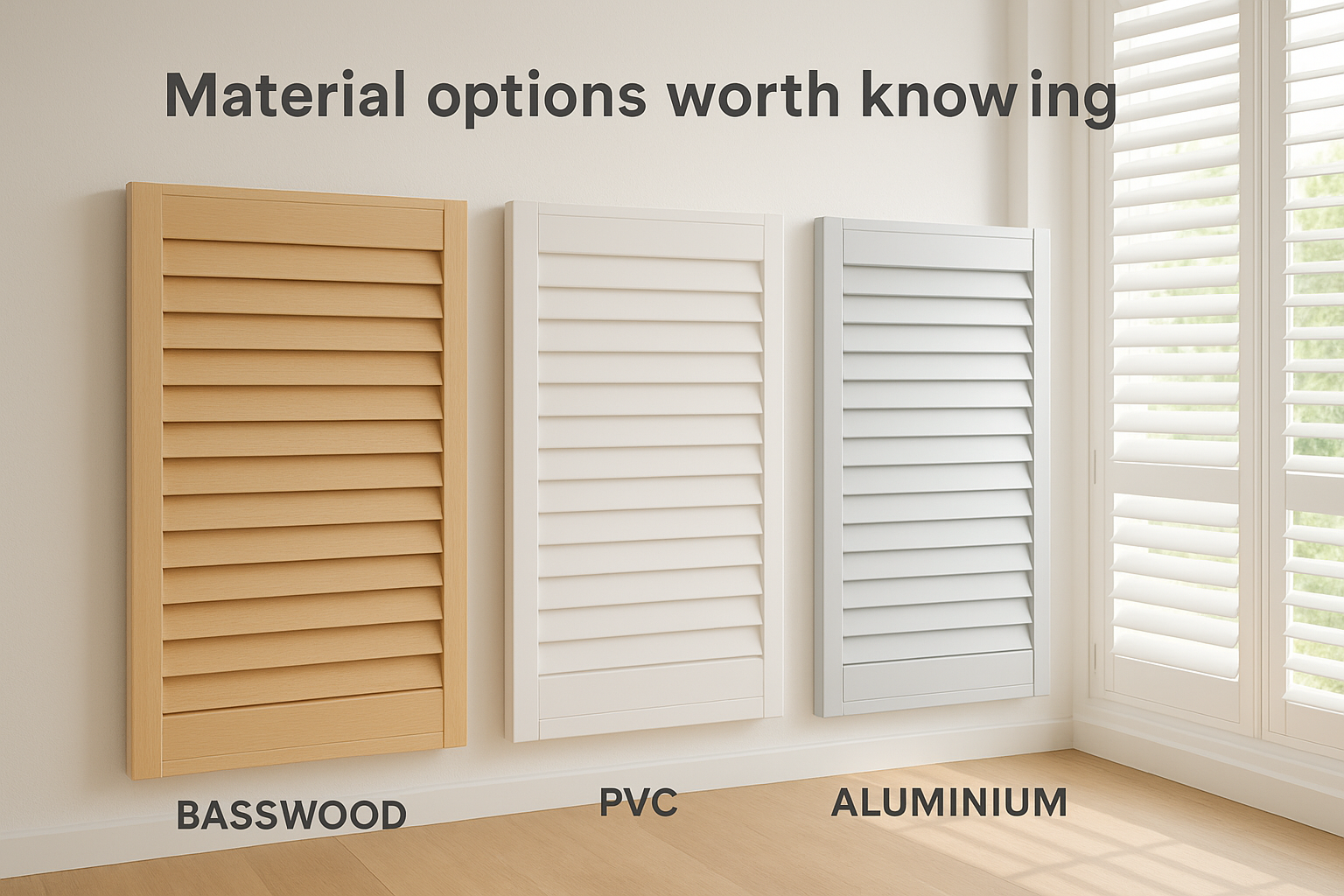
If your home sits near the coast or has rooms with high moisture levels, avoid solid timber shutters in those spaces regardless of how well they are finished.
Aluminium composite shutters are the most durable option for outdoor-facing applications or large commercial openings. They handle temperature swings without expanding and contracting the way timber does, which keeps the mechanism working smoothly over time.
Shutter styles and louvre sizes
Louvre width affects both the look of your shutters and how much light and airflow you can control. Narrower louvres (around 63mm) suit traditional interiors, while wider louvres (89mm to 114mm) suit contemporary homes and work well over large windows where an unobstructed view matters. Full-height shutters cover the entire window opening and are the most popular option in Adelaide homes. Bi-fold and sliding configurations work well for wider openings, bay windows, or doors where a hinged panel would be impractical.
Costs, lead times and what affects the price
Australian made plantation shutters cost more upfront than imported alternatives, and that gap is real. You are paying for local labour, quality materials, and a supply chain you can trace, which adds to the base price but reduces the risk of expensive problems down the track. Understanding what drives pricing helps you compare quotes properly rather than defaulting to the cheapest option.
What influences the final price
Material choice is the single biggest cost factor. Basswood timber shutters sit at the higher end of the price range, while PVC and composite options come in lower. Window size and configuration also push costs up quickly: larger openings, arched frames, bi-fold tracks, and non-standard shapes all require additional labour and custom components. Colour plays a role too. Standard white or off-white finishes are priced into most base quotes, but custom paint colours and stained timber finishes carry a premium because they require additional preparation and finishing time.
Get your quote broken down by window rather than as a single lump sum, so you can see exactly where the cost sits and compare like for like across suppliers.
Lead times and what to expect
Locally manufactured shutters typically take four to eight weeks from confirmed order to installation, depending on the complexity of your job and the manufacturer’s current workload. Imported shutters often run eight to sixteen weeks or longer, and any mistake in the order adds another full production cycle on top of that. If you are working to a specific move-in date or a builder’s schedule, the shorter local lead time alone can make the decision straightforward. Always confirm the estimated installation date in writing before you pay a deposit.
How to compare suppliers and get it installed
Choosing between suppliers of australian made plantation shutters comes down to more than price. You need to verify that the supplier manufactures locally, can handle your specific window configurations, and backs their work with a clear warranty. Two quotes might look similar on paper but represent very different levels of service and product quality.
Questions to ask before you commit
Before you agree to anything, put your questions to the supplier directly and in writing. Genuine local manufacturers will answer confidently because they have nothing to hide. Ask where the shutters are physically built, how long they have been operating, and what happens if a component fails after installation. These questions separate credible suppliers from those leaning on vague marketing claims.
A supplier who deflects straightforward questions about their manufacturing process is telling you something important.
Use this checklist when comparing suppliers:
- Can they show you a physical sample made at their own facility?
- Do they carry spare parts locally?
- Is the warranty on materials and labour clearly stated in writing?
- What is the confirmed lead time from order to installation?
What the installation process looks like
A professional installer will measure your windows on-site before anything goes into production, not rely on measurements you supply yourself. That single step eliminates most ordering errors. On installation day, expect the job to take a few hours per room, depending on the number of windows and the configuration involved.
After installation, a good supplier walks you through how to operate and maintain your shutters properly, covering tilt adjustment, cleaning methods, and what to watch for as the product settles into the frame over the first few weeks.
Your next step
You now have a solid foundation for evaluating australian made plantation shutters without getting caught out by vague claims or misleading marketing. The key points to carry forward are straightforward: confirm local manufacturing, match the material to your climate and room type, get your quote broken down by window, and verify the warranty in writing before you pay anything.
If you are ready to take the next step, the team at Classic Roller Shutters Adelaide offers free in-home consultations across Adelaide and the surrounding areas. With over 40 years of experience fitting window coverings in South Australian homes, we can assess your windows on-site, walk you through your material and style options, and give you a clear, itemised quote with no pressure attached. Get in touch with Classic Roller Shutters Adelaide to book your free consultation and find out what locally sourced, professionally installed shutters look like in your home.