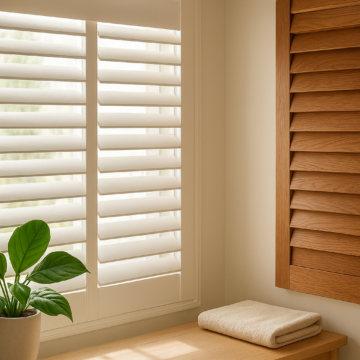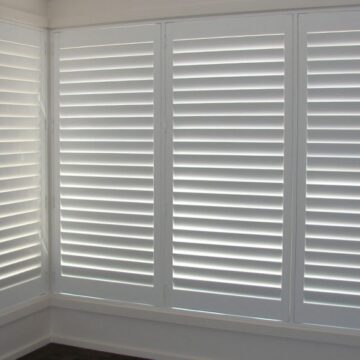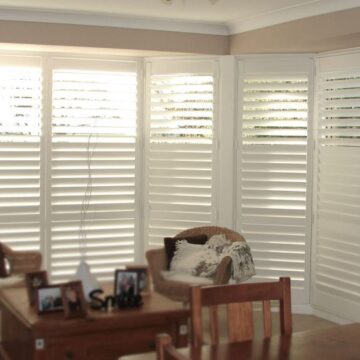
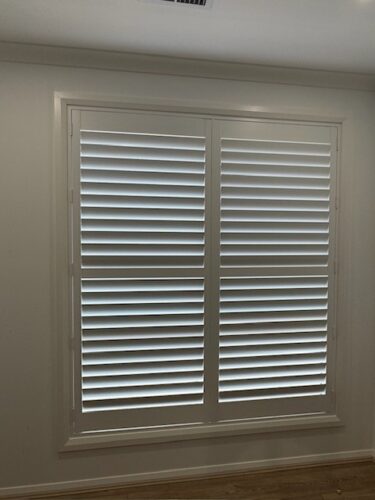
If you’ve ever wondered how do plantation shutters work, you’re not alone. They look clean and sharp on a window, but the actual mechanics behind them, how the louvres tilt, how the panels open, how they control light so precisely, aren’t always obvious from the outside. Understanding how they function helps you decide whether they’re the right fit for your home before you spend a cent.
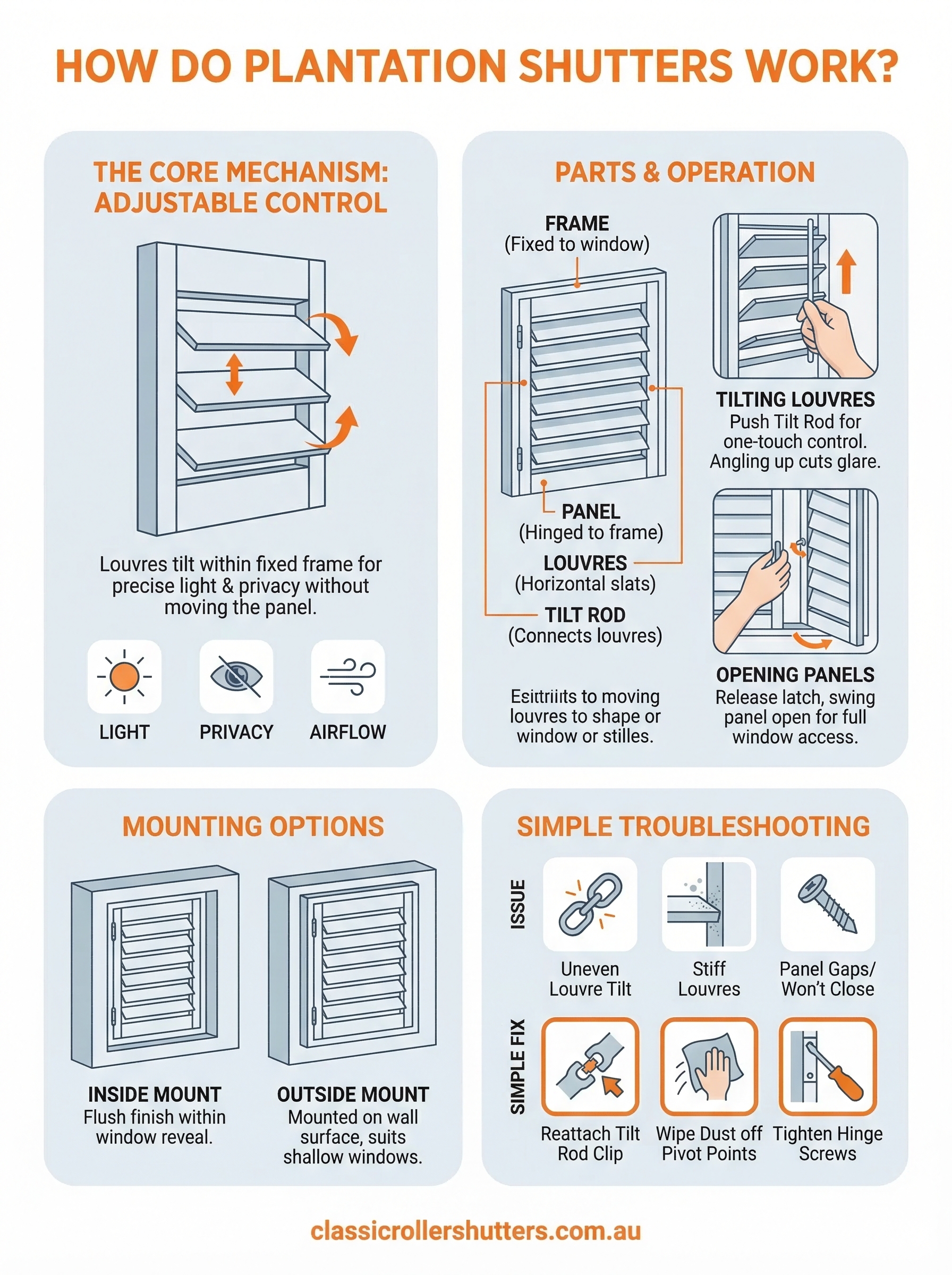
At their core, plantation shutters use a simple but effective system of adjustable louvres mounted within solid panels that attach to your window frame. You control how much light enters a room, how much privacy you get, and how much airflow passes through, all by tilting those louvres or swinging the panels open. It’s a straightforward design that gives you a surprising amount of control over your living space.
At Classic Roller Shutters Adelaide, we supply and install plantation shutters across Adelaide as part of our full range of window coverings. With over 40 years in the industry and a local factory right here in SA, we know these products inside and out. This article breaks down exactly how plantation shutters work, from panel construction and louvre operation to the way they manage light, privacy, and insulation in your home.
Why plantation shutters work differently to blinds
Most window coverings, whether roller blinds, venetian blinds, or Roman shades, work by moving the entire covering up or down to expose or block a window. Plantation shutters don’t do that. Instead, they sit permanently within or against your window frame, and you adjust the louvres to change the light and privacy level without moving the shutter itself. That fundamental difference in how plantation shutters work shapes everything from their day-to-day feel to their long-term performance.
The frame stays fixed, the louvres move
When you install a plantation shutter, a solid frame mounts directly to your window reveal or wall. The panels hinge off that frame like a door off a doorjamb. You only swing them open when you need full access to the window, such as for cleaning the glass or letting air through a flyscreen. Day to day, the panels stay closed and you simply tilt the louvres using a tilt rod or by touching the louvres themselves.
This design means the shutter takes up no extra space above or beside your window. Compare that to a roller blind that rolls into a cassette at the top, or a venetian blind that stacks up in layers when raised. Plantation shutters keep the same compact footprint whether the louvres are angled open or shut.
Unlike blinds that retract entirely, plantation shutters let you control light and privacy without ever moving the panel away from the window.
How light control compares
With a standard roller blind, your main options are fully up or fully down, with limited settings in between. Plantation shutters give you a continuous range of adjustment. You can tilt the louvres to a shallow angle and let in filtered, diffused light while still blocking a direct sightline into your room. Push them to a steeper angle and you get more brightness. Close them flat and you get a near-complete block of both light and view.
This level of control also affects heat and glare management in your home. By angling louvres upward, you redirect sunlight toward the ceiling rather than straight into the room, which cuts glare on screens and reduces heat build-up near the glass.
The parts that make plantation shutters work
Understanding how do plantation shutters work begins with knowing what each component actually does. Every shutter uses a small set of parts, and each one plays a specific role in how you control light, privacy, and airflow at your window.
The frame and panels
The outer frame bolts directly to your window reveal or sits flat against the surrounding wall. Panels hinge off this frame, and each panel holds a set of louvres within a solid stile and rail border. The stiles run vertically down each side, and the rails run horizontally across the top and bottom. Together, they hold the louvres securely while still allowing them to pivot freely.
Louvres and the tilt rod
Louvres are the horizontal slats that do the actual work of controlling light. They sit between the stiles and pivot on a central pin at each end. A vertical tilt rod connects to every louvre in the panel, so when you push the rod up or down, all louvres move together in a single, even motion.
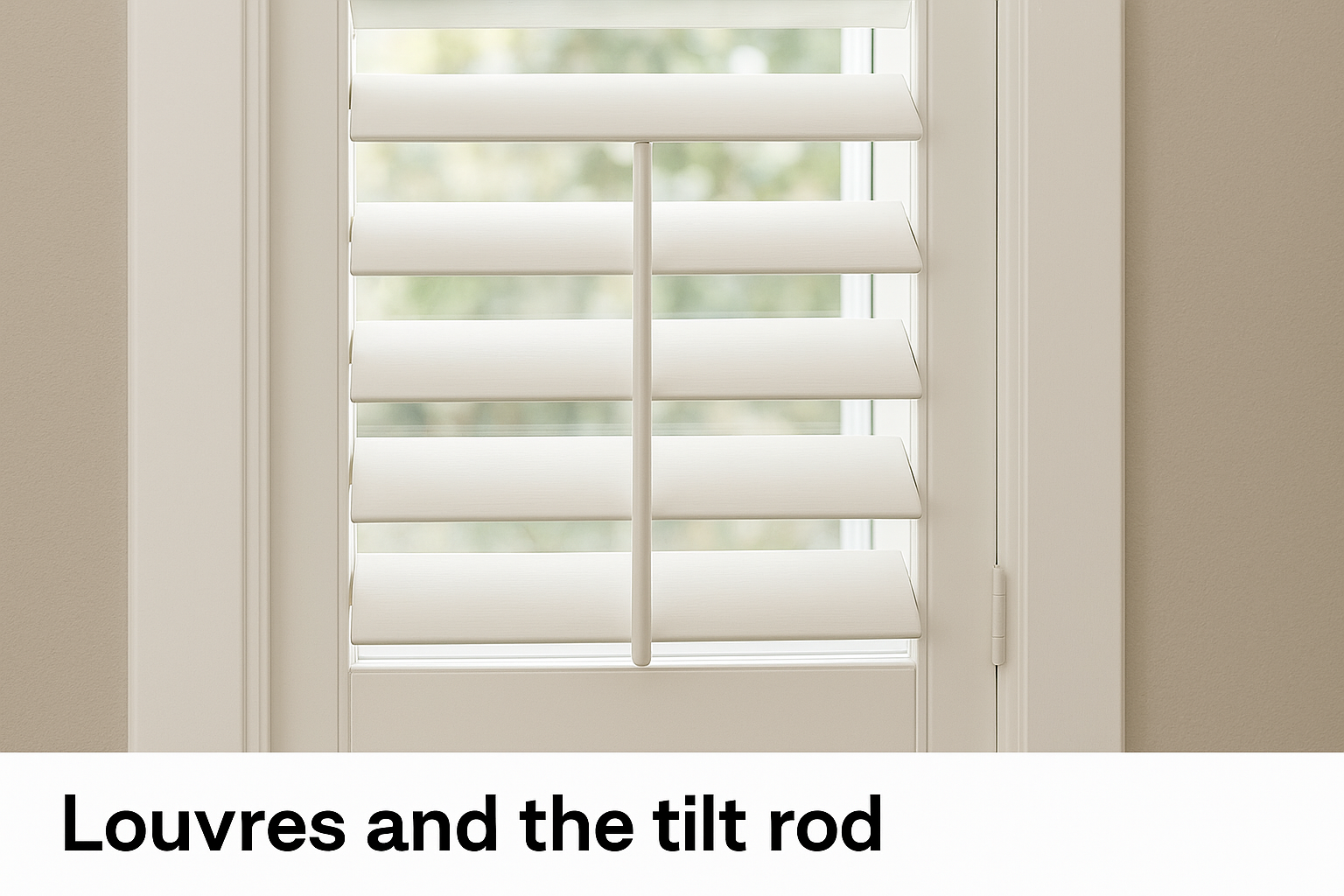
The tilt rod is the single mechanism that links every louvre in a panel, giving you one-touch control over the entire window.
Louvre width is typically measured in millimetres, with 63mm, 89mm, and 114mm being the most common sizes. Wider louvres let in more light when open and give you a more unobstructed view through the glass when the panels are in use.
How to operate plantation shutters day to day
Once you know what the parts do, the day-to-day use of plantation shutters is straightforward. You have two main actions at your disposal: tilting the louvres to adjust light and privacy, and swinging the panels open when you need full access to the window behind them.
Tilting the louvres
To tilt the louvres, you push the tilt rod up or down, or touch any single louvre directly if your shutter uses a hidden tilt mechanism. Either way, all the louvres in that panel move in one clean motion. Angling them upward redirects sunlight toward the ceiling, which cuts glare without darkening the room. Push them the other way and you block more light while still allowing some airflow through the gaps.
Tilting louvres upward rather than downward gives you privacy from street level while keeping your room bright.
Opening the panels
You open the panels by releasing the magnetic catch or latch at the centre of the frame, then swinging the panel outward like a door. This is how plantation shutters work when you need to clean the glass, open a window, or let in a breeze through a screen. Most people only open the panels a handful of times per week; louvre adjustment handles the bulk of the day-to-day work.
How plantation shutters fit your window or door
The way plantation shutters attach to your window directly affects how they look and how they function day to day. Two main mounting methods exist, and the right choice depends on your window reveal depth, frame condition, and the overall finish you want in the room.
Inside mount
An inside mount fits the shutter frame directly within your window reveal, so the panels sit flush with the surrounding wall. This approach gives a clean, architectural finish that makes the shutter look like part of the window rather than something added later. Your reveal needs enough depth to seat the frame without the panels fouling against the glass or sill.
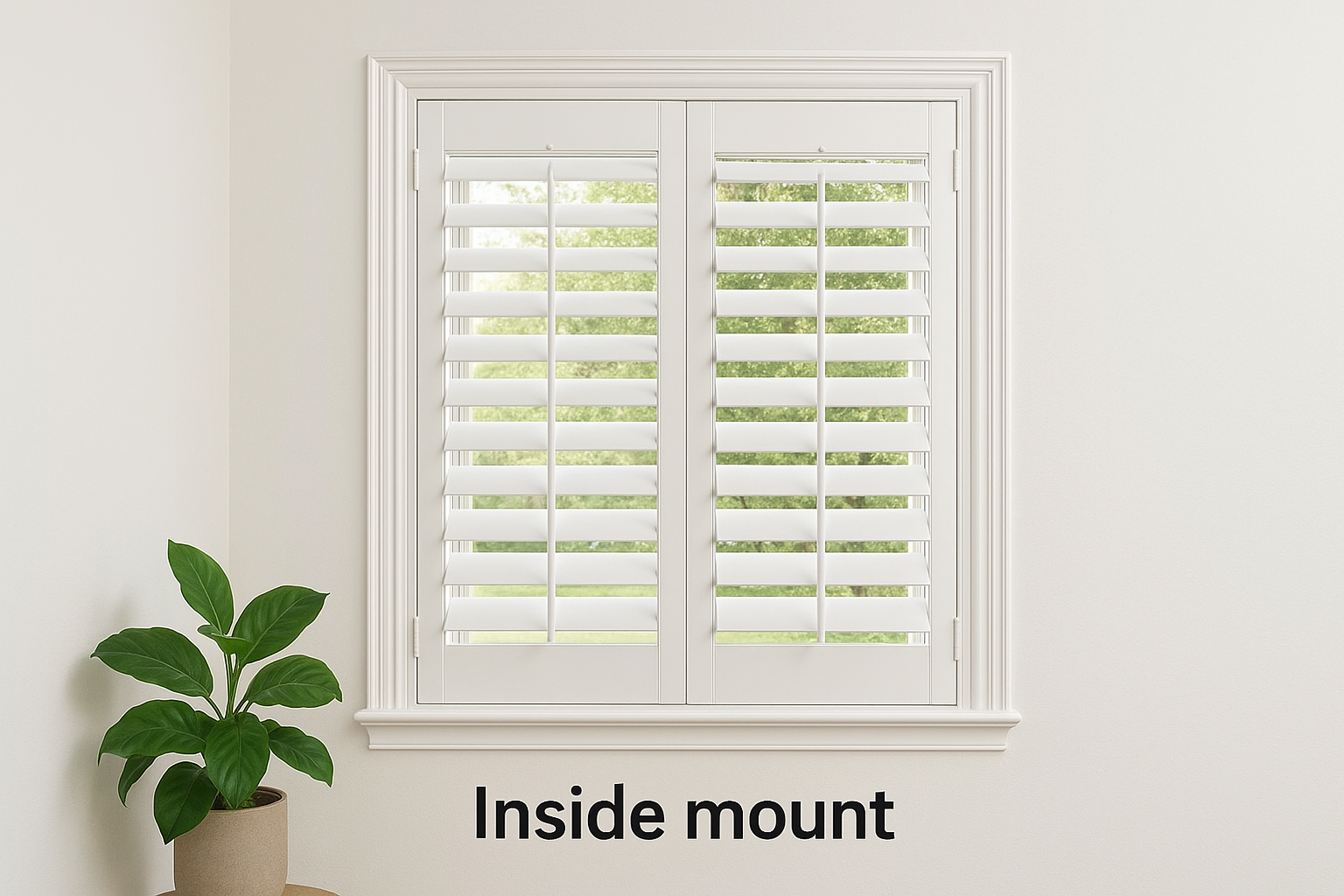
An inside mount gives plantation shutters their characteristic built-in look, as though they were always part of the window architecture.
Outside mount
Outside mounts position the frame on the wall surface surrounding your window rather than inside the reveal. This suits shallow windows or irregular frame shapes that don’t offer enough depth for a flush fit. An outside mount also covers a slightly larger area of wall, which helps reduce light gaps around the edges.
Understanding how do plantation shutters work in your specific window type matters before you place an order. Once you settle on a mounting method, you then choose a panel configuration, whether bi-fold, single panel, or French style, to match how the window opens and how you use the space around it.
Common issues and simple fixes
Even well-made shutters develop small problems over time. Knowing how do plantation shutters work mechanically makes it much easier to spot what’s gone wrong and fix it without calling a technician.
Louvres that won’t tilt evenly
This usually points to a loose or disconnected tilt rod. The rod clips onto each louvre at a small staple, and if one breaks, that louvre drops out of sync. You can press the clip back into place yourself, or pick up a replacement staple from a shutter parts supplier without buying a whole new panel.
If the louvres move stiffly rather than freely, dust build-up on the pivot points is almost always the cause. A dry cloth wiped along each louvre clears the friction in under a minute.
Stiff louvres are rarely a structural problem; dust is the most common culprit and costs nothing to fix.
Panels that won’t close flush
A panel that gaps at the centre or catches on the frame typically has a hinge that’s worked loose. Tighten the screws with a standard screwdriver. If the screws no longer grip, fill the holes with a wooden toothpick and wood glue, let it cure, then re-drive the screws.
Timber shutters can warp slightly in high-humidity rooms, which pulls panels out of alignment. A shutter repair specialist can re-square the frame without replacing the entire unit, keeping costs well below a full replacement.
Next steps
Now you understand how do plantation shutters work, from the tilt rod connecting each louvre to the mounting frame that keeps everything flush against your window. The mechanics are straightforward, and that simplicity is exactly what makes them a reliable, long-lasting option for Adelaide homes and commercial spaces.
Choosing the right louvre size, panel configuration, and mounting method makes a real difference to how your shutters look and perform. Getting those decisions right from the start saves you time, money, and frustration down the track. The best way to do that is to see the options in person and get advice tailored to your specific windows and rooms.
Classic Roller Shutters Adelaide has over 40 years of experience helping homeowners across South Australia choose and install the right window coverings. Visit Classic Roller Shutters Adelaide to book a free in-home consultation or browse our full range.